
Standard Nylon Cable Ties
Shop standard nylon cable ties for organising cables, securing suitable bundles and everyday fastening jobs. Choose from compact 2.5 mm ties, medium-width 3.6 mm ties and general-purpose 4.8 mm zip ties in multiple lengths, colours and pack quantities.
Use the filters to compare the required width, length and colour. Always check the individual product page for maximum bundle diameter, material, temperature range, UV resistance and verified tensile strength.
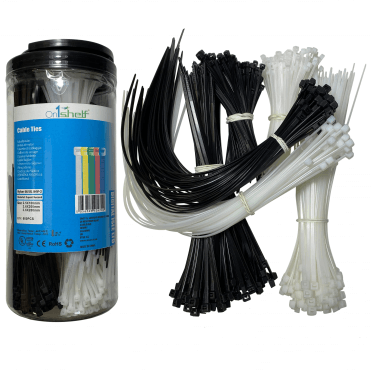
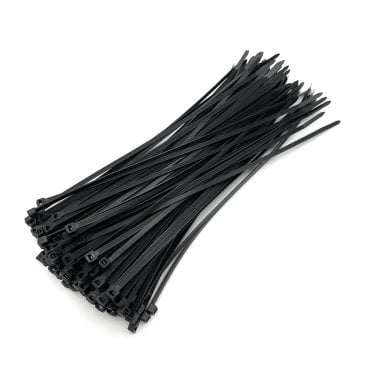
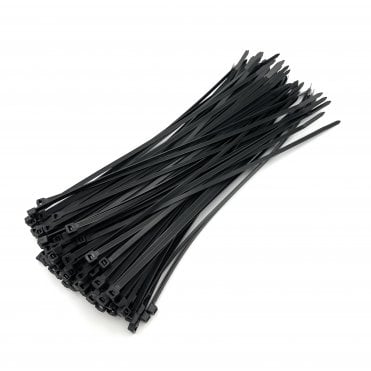
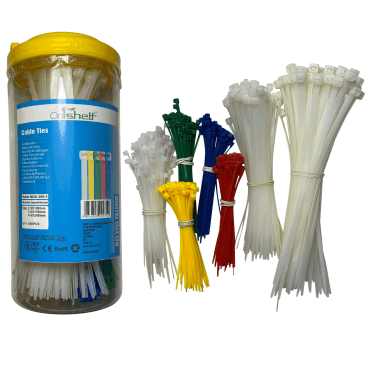
Standard Nylon Cable Ties for Everyday Fastening
Standard cable ties provide a quick way to bundle cables, organise wiring and secure suitable lightweight components. They are also commonly called zip ties, tie wraps, plastic ties or nylon ties.
A standard non-releasable cable tie has a toothed strap and locking head. The tail passes through the head and tightens into a one-way loop. Once installed, the tie will normally need to be cut for removal. For applications that must be opened and closed repeatedly, choose a purpose-made releasable cable tie instead.
Choosing the Correct Cable Tie Width and Length
The correct size depends on the diameter of the intended bundle, the required strength and the space available around the installation. Length determines how large a loop can be formed, while width and construction affect the tie's mechanical performance.
- 2.5 mm wide cable ties: compact ties for small wires, components, labelling tasks and lighter cable bundles. The current range includes 100 mm and 160 mm lengths.
- 3.6 mm wide cable ties: a useful intermediate size for general cable management where a 2.5 mm tie is too small but a wider tie is unnecessary. Available lengths include 200 mm, 300 mm and 370 mm.
- 4.8 mm wide cable ties: general-purpose nylon ties for larger bundles and a wider range of fastening jobs. Current options include 200 mm, 250 mm, 300 mm, 350 mm, 450 mm and extra-long 920 mm lengths.
Available sizes, colours and pack quantities can vary. Check the selected product and variation before ordering.
Do not choose a cable tie by length alone. Confirm that the stated maximum bundle diameter is large enough while still allowing sufficient tail to pass fully through the locking head. Avoid selecting an unnecessarily oversized tie where space is limited or the bundle could be damaged by excessive tightening.
Check the Verified Tensile Strength
Cable-tie strength cannot be established reliably from strap width alone. Products with similar dimensions may use different materials, locking-head designs and manufacturing standards.
Use only the minimum loop tensile strength documented for the exact product and size. Do not reuse a strength figure from another cable tie simply because it has the same width. Laboratory tensile figures must also not be treated as a universal safe working-load rating for a completed installation.
Black, White and Coloured Cable Ties
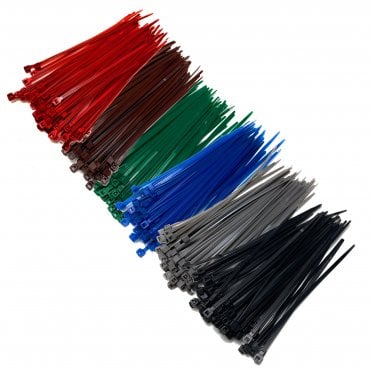
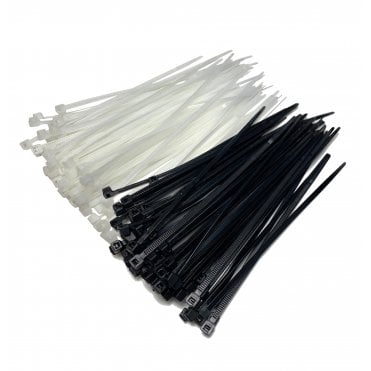
Standard nylon cable ties are available in black, white or natural nylon and selected colours. Colour can be useful for identifying cable groups, circuits, departments, stock, equipment or installation stages.
Colour alone does not establish UV resistance, temperature performance or suitability for outdoor installation. A black tie should only be described as UV-resistant when that property is confirmed for the exact material and product. For prolonged sunlight or exposed outdoor use, select a cable tie specifically documented as UV-stabilised or weather-resistant.
For a broader selection organised specifically by colour, visit our coloured cable ties department.
Common Uses for Standard Zip Ties
- Bundling electrical cables and wires
- Organising computer, television and network leads
- Routing suitable wiring inside equipment and cabinets
- Grouping workshop tools, accessories or components
- Securing lightweight packaging and bundled items
- Colour-coding cable runs and equipment
- Temporary organisation during installation or maintenance
- General home, garage, office and DIY fastening tasks
These are general examples rather than universal approvals. Check whether the selected tie is suitable for the load, material, temperature, movement and environment involved.
Standard, Heavy-Duty or Releasable Cable Ties?
Standard ties are suitable for many everyday cable-management and fastening jobs, but they are not the correct choice for every installation.
- Choose standard nylon cable ties for ordinary, permanent bundling where the tie can be cut during removal.
- Choose heavy-duty cable ties when the application requires a wider tie, larger bundle capacity or greater verified tensile strength.
- Choose releasable cable ties when the bundle must be opened, adjusted or reused.
- Choose stainless-steel cable ties for suitable high-temperature, corrosive or demanding environments where the specified metal construction is required.
- Choose special cable ties for applications requiring features such as identification markers, double locking, metal detection or a specialist head design.
- Choose cable-tie mounts and fixing accessories when a bundle must be secured to a suitable surface or fixing point.
How to Install a Standard Cable Tie
- Check that the selected tie has the correct material, size and specification.
- Place the tie around the cable bundle or suitable item.
- Insert the tail through the locking head in the correct direction.
- Pull the tail gradually until the bundle is held securely.
- Do not overtighten around soft cable insulation, tubing or delicate components.
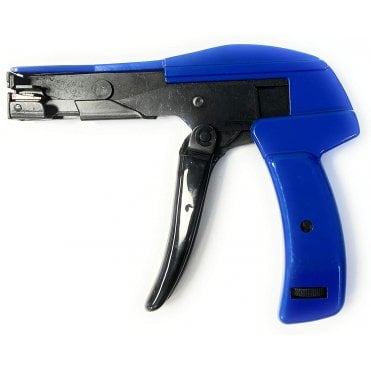
- Trim the remaining tail with an appropriate cable-tie cutting tool if required.
- Leave the cut end smooth and flush to reduce the risk of sharp projecting edges.
Do not use general-purpose cable ties as lifting equipment, fall protection, vehicle load restraints, structural fixings or safety-critical supports. Where unexpected release could cause injury or serious damage, use a properly rated fastening system and any required secondary restraint.
Frequently Asked Questions
Are cable ties, zip ties and tie wraps the same product?
These names are commonly used for the same type of ratcheting fastener. “Cable tie” is the usual UK product name, while “zip tie” and “tie wrap” are also widely understood.
Which cable-tie size should I choose?
Check the required bundle diameter first, then compare the available length, width and verified tensile specification. Allow enough additional length for the tail to pass securely through the locking head.
Are all black cable ties suitable for outdoor use?
No. Black colour alone does not prove that a tie is UV-stabilised. Use an outdoor installation only when UV or weather resistance is explicitly documented for the exact product.
Can standard cable ties be reused?
Standard ties are normally non-releasable and intended for one-time installation. Although the locking pawl can sometimes be manipulated, doing so can damage the tie or reduce its reliability. Use a purpose-made releasable tie when repeated opening is required.
How much weight can a nylon cable tie hold?
There is no department-wide weight rating. Performance depends on the exact tie, material, width, locking design, installation, temperature, ageing and direction of force. Use the verified minimum loop tensile strength for the selected product, not an estimate based only on size.
Can two cable ties be joined to make a longer tie?
Cable ties can sometimes be linked, but this creates additional connection points and should not be treated as equivalent to one correctly sized tie. Use a purpose-made longer cable tie where security or predictable performance matters.
What is the safest way to remove a cable tie?
Use suitable cutters and keep the cutting edge away from the enclosed cables or components. Do not pull or twist the tie off where this could damage the bundle.