
Heavy-Duty Rubber Wheel Chocks for Cars, Caravans & Trailers
Shop heavy-duty rubber wheel chocks for helping to prevent parked cars, caravans, trailers and other compatible vehicles from rolling. Choose from our 1.3kg and 3kg designs, available as individual chocks or practical pairs.
Vehicle weight alone does not determine suitability. Check the selected chock’s dimensions, construction and documented capacity against your vehicle, tyre and intended surface before use.
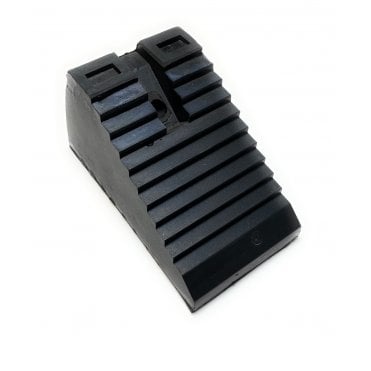
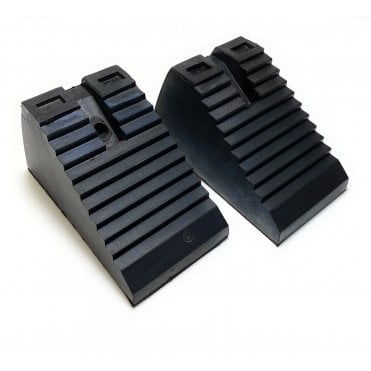
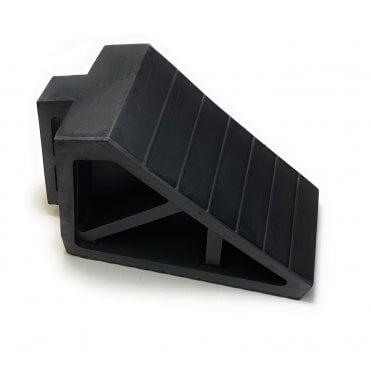
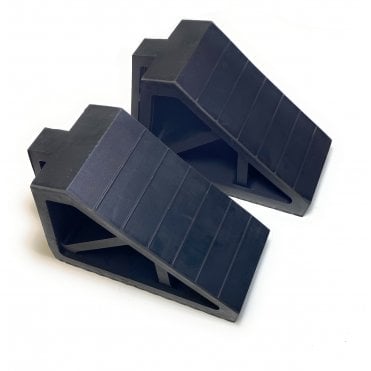
Heavy-Duty Rubber Wheel Chocks
Rubber wheel chocks are wedge-shaped blocks positioned against a vehicle tyre to help restrict unwanted wheel movement while the vehicle is parked. They can be used with compatible cars, caravans, trailers and selected light commercial vehicles, subject to the specification of the exact chock.
Rubber construction provides a hardwearing alternative to lightweight hollow designs and is suitable for regular garage, driveway, storage and caravan use. The correct size and rated capacity must still be selected for the vehicle, tyre and operating conditions.
Choose Between 1.3kg and 3kg Wheel Chocks
Our current range includes 1.3kg and 3kg wheel-chock designs, with single and paired pack options. The heavier product is not automatically suitable for every larger vehicle. Weight is only one characteristic: compare its dimensions, tyre contact area, surface pattern and documented capacity before ordering.
1.3kg Rubber Wheel Chocks
The more compact 1.3kg design is suited to compatible cars, trailers and caravans where its dimensions and capacity meet the vehicle manufacturer's requirements. Choose a single chock for replacing or matching an existing unit, or a pair where two matching chocks are required.
3kg Heavy-Duty Wheel Chocks
The larger 3kg design offers a more substantial rubber block for compatible vehicles and equipment. Confirm the complete dimensions and any stated load or tyre-size limitations on the product page rather than selecting it by weight alone.
How to Select a Wheel Chock
- Check the vehicle or equipment manufacturer's wheel-chocking instructions.
- Compare the chock dimensions with the tyre diameter and tread width.
- Confirm any documented load or vehicle-weight rating.
- Consider whether one chock or a matching pair is required.
- Check that the intended ground is firm, stable and suitable for the chock.
- Inspect the chock for cracks, deformation or excessive wear before every use.
Do not assume that a heavier chock automatically has a higher rated capacity. Add verified load-capacity information to each product page when supplier documentation is available.
Using Wheel Chocks Safely
Apply the vehicle's parking brake and select the correct gear or park position before placing the chocks. Position them firmly against the tyres in the direction from which movement could occur, following the vehicle or equipment manufacturer's instructions.
Wheel chocks are not lifting equipment and must never be treated as a substitute for an approved jack, axle stands or other correctly rated vehicle-support equipment. Never work beneath a vehicle supported only by wheel chocks.
Avoid using a chock on unstable, loose or severely uneven ground unless the product and equipment instructions specifically permit it. Replace damaged or badly worn chocks rather than attempting to repair them.
Single Wheel Chocks or a Pair?
A single option is useful when replacing an existing chock or where the equipment instructions specify one. A matching pair allows two tyres or both sides of one tyre to be restrained when required. The correct number and position depend on the vehicle, gradient and manufacturer’s instructions.
Related Mats and Flooring
For garage and workshop floor protection, browse our industrial rubber mats and flooring. You can also view the complete mats and flooring range.
Frequently Asked Questions
What does a wheel chock do?
A wheel chock is placed firmly against a tyre to help restrict the wheel from rolling while the vehicle or equipment is stationary.
Is a 3kg wheel chock better than a 1.3kg chock?
Not automatically. Suitability depends on dimensions, construction, tyre compatibility, ground conditions and documented capacity—not product weight alone.
Should wheel chocks be used in pairs?
Pairs are commonly used where two matching restraint points are required, but the correct quantity and positioning should follow the vehicle or equipment manufacturer’s instructions.
Can wheel chocks replace axle stands?
No. Wheel chocks help restrict wheel movement; they are not designed to lift or support a vehicle and must not replace correctly rated axle stands.
Can rubber wheel chocks be used with caravans and trailers?
They can be used with compatible caravans and trailers when their dimensions and documented capacity meet the equipment manufacturer’s requirements.