
Coloured Nylon Cable Ties
Shop coloured cable ties for cable identification, organisation and everyday fastening. Choose from black, white, red, blue, green, yellow, brown, grey and silver ties in selected widths, lengths and pack quantities.
Use the filters to compare colour and size, but always check the individual product specification for material, maximum bundle diameter, verified tensile strength and environmental suitability.
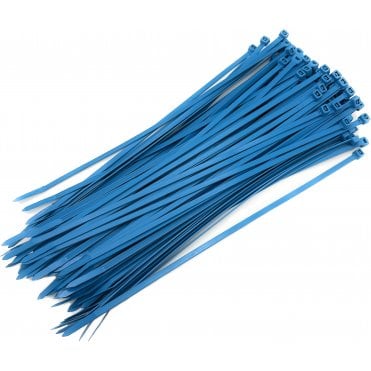
Coloured Cable Ties for Identification and Organisation
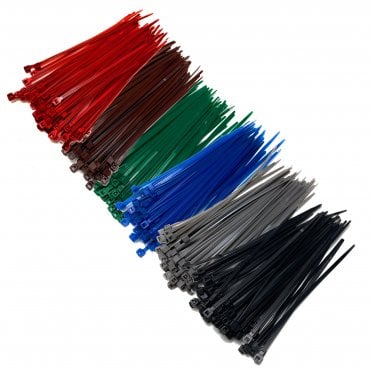
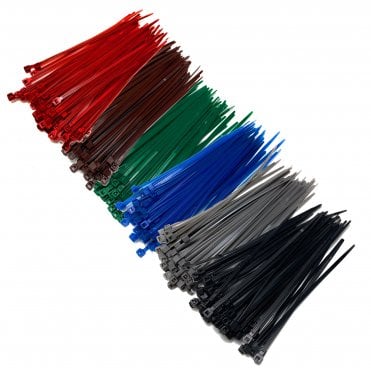
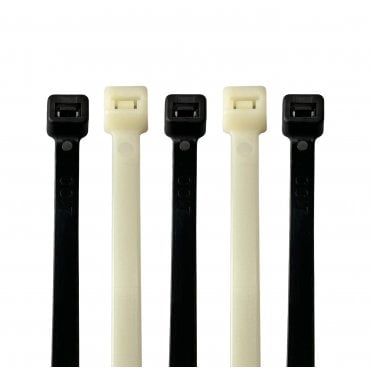
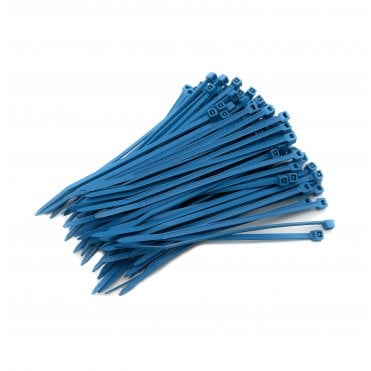
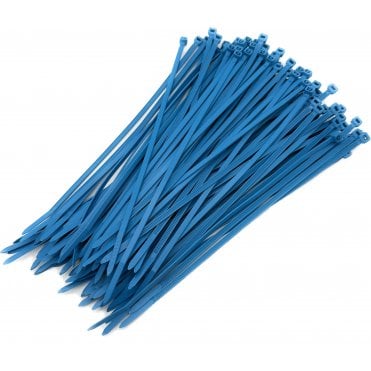
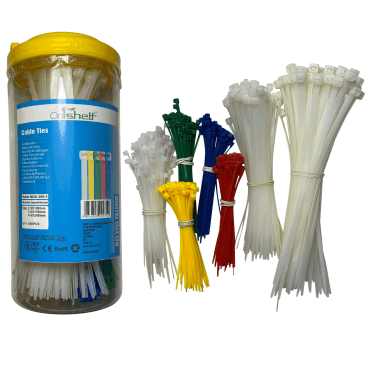
Coloured cable ties make it easier to organise cables, identify different bundles and separate components by project, location or purpose. The On1shelf range includes individual colours and assorted packs in a selection of standard, wide, long and heavy-duty sizes.
These ties are also commonly called coloured zip ties, tie wraps or plastic cable ties. Most standard versions use a toothed nylon strap and a one-way locking head, although selected releasable and specialist constructions may also be available.
Choose Cable Ties by Colour
The available range includes black, white, red, blue, green, yellow, brown, grey and silver cable ties. Colour can be used to distinguish cable groups, installation stages, stock, tools, equipment or work areas.
- Red cable ties: useful where a clearly visible marking or contrasting fastening is required.
- Blue cable ties: suitable for creating a separate, easily recognised cable or component group.
- Green cable ties: useful for identification and for blending with selected gardening or landscaping materials.
- Yellow cable ties: a high-visibility option for marking or identifying suitable bundles.
- Brown cable ties: suitable where the fastening needs to blend with wood, fencing or other brown materials.
- Grey and silver cable ties: useful around grey cable, equipment, metal-effect surfaces or neutral installations.
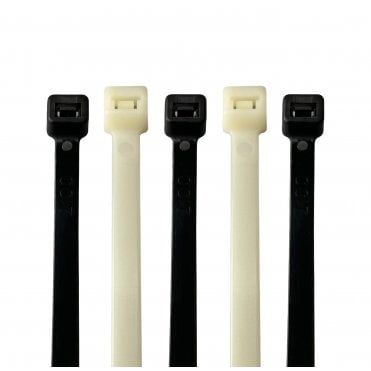
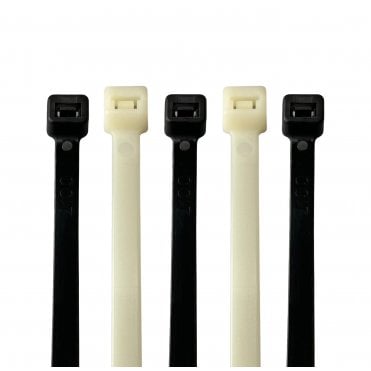
- Black and white cable ties: practical general-purpose colours for contrasting with or matching the surrounding installation.
These are examples, not recognised electrical or safety classifications. There is no universal colour code applying to every workplace or installation. Create and document your own consistent system where colours are being used for identification.
Colour Does Not Confirm the Technical Specification
Do not select a cable tie by colour alone. Two ties of the same colour can have different widths, lengths, locking designs, materials and tensile specifications.
Black colour does not automatically prove that a tie is UV-stabilised or suitable for permanent outdoor use. Likewise, a blue cable tie is not necessarily metal-detectable or approved for food-production environments. These properties must be confirmed for the exact product.
Where temperature, chemicals, ultraviolet exposure, vibration or moisture could affect performance, check the individual product specification before installation.
Choose the Correct Width and Length
Length determines the approximate loop size that can be formed, while width and construction influence the mechanical performance of the tie. The usable loop will always be smaller than the total length because part of the strap must pass through the locking head.
Measure the intended bundle and compare it with the stated maximum bundle diameter. Allow enough additional strap to feed through the head without choosing an unnecessarily oversized tie.
Cable-tie strength must be verified for the exact size and construction. Do not transfer a tensile figure from another tie simply because it has the same width or colour.
Individual Colours and Assorted Packs
Choose an individual colour when one consistent identification or appearance is required. Assorted packs are more practical when several colours are needed for different cable groups, projects or work areas.
Check the product page carefully before ordering an assorted pack. The total quantity, number of each colour, dimensions and colour combination can differ between packs.
Standard, Heavy-Duty and Releasable Coloured Ties
- Choose coloured standard cable ties for everyday identification, cable organisation and non-releasable fastening.
- Choose heavy-duty cable ties when width, bundle capacity or verified tensile performance is more important than colour.
- Choose standard nylon cable ties for the complete general-purpose range organised by size.
- Choose releasable cable ties when the fastening must be opened, adjusted or reused.
- Choose special cable ties when metal detection, temperature resistance, identification markers or another specialist construction is required.
Common Uses for Coloured Zip Ties
- Identifying separate cable and wiring groups
- Organising computer, network and entertainment cables
- Separating stock, components or project materials
- Marking equipment belonging to different departments
- Matching ties to displays, decorations or surroundings
- Organising workshop, garage and maintenance supplies
- Securing suitable garden netting, plants or fencing materials
These are general examples rather than universal product approvals. Do not use ordinary nylon cable ties as lifting equipment, fall protection, vehicle load restraints, structural fixings or safety-critical supports.
Frequently Asked Questions
What are coloured cable ties used for?
They are commonly used for bundling and organising cables while making different groups easier to identify. They can also be selected to contrast with or blend into the surrounding materials.
Do cable-tie colours have official meanings?
Not universally. Some businesses create their own colour-coding systems, but a colour should not be assumed to have a particular electrical, safety or technical meaning unless the system has been clearly documented.
Are black cable ties always UV-resistant?
No. Black pigment alone does not confirm UV stabilisation. Check whether outdoor or UV resistance is explicitly documented for the selected product.
Are blue cable ties metal-detectable?
Not necessarily. Metal-detectable ties are often blue to make them easier to see, but an ordinary blue nylon cable tie does not contain detectable material.
Which coloured cable-tie size should I choose?
Measure the intended bundle, then compare the maximum bundle diameter, length, width and verified tensile specification. Colour should be chosen only after confirming the required technical properties.
Can coloured cable ties be reused?
Most standard coloured ties are non-releasable and normally need to be cut during removal. Choose a purpose-made releasable tie if the fastening must be opened repeatedly.